
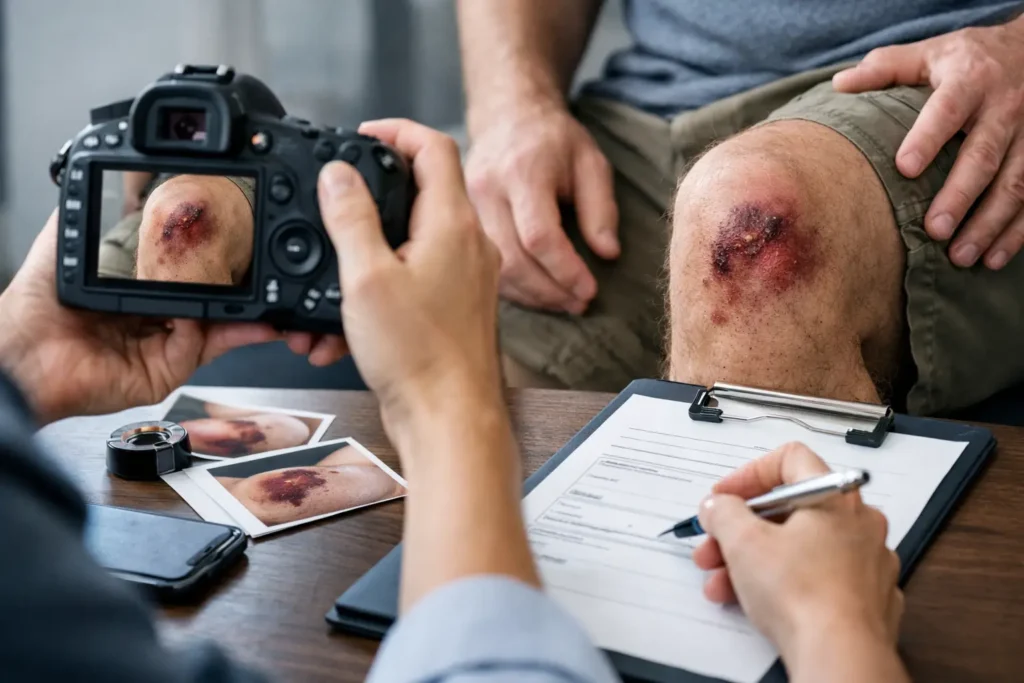
Why injury evidence matters so much
A personal injury claim is not just about saying you were hurt. It is about proving how the injury happened, what your condition was afterward, what treatment you needed, and how the injury affected your daily life. Even very real injuries can be challenged if there is little documentation.
Insurance companies often look for gaps. If there are no photos from the scene, they may argue the hazard was minor. If you waited to get medical care, they may claim the injury was not serious. If you cannot show how your work, sleep, mobility, or pain changed after the accident, they may try to reduce the value of your claim.
This is why documentation is not busywork. It is protection. It helps preserve facts while they are still fresh and gives your attorney something concrete to build from.
How to document injury evidence at the scene
If you can do so safely, start gathering evidence right away. Your health comes first, so do not stay in a dangerous area just to take pictures. But if you are able, use your phone to capture the scene before vehicles are moved, spills are cleaned, or defective conditions are repaired.
Photographs usually matter more than people expect. Take wide shots that show the overall scene and close-up images that show details. If it is a car accident, photograph vehicle damage from multiple angles, skid marks, traffic signs, debris, broken glass, weather conditions, road layout, and any visible injuries. If it is a slip and fall, capture the floor condition, liquid or debris, poor lighting, warning signs or lack of them, and anything that may have contributed to the fall.
Video can also help because it shows scale and context in a way still photos sometimes do not. A short slow pan of the area may capture details you do not realize are important until later.
Try to get the names and contact information of witnesses. Independent witnesses can be valuable because they are often seen as more neutral than the people involved. If police or store management respond, make note of their names and ask how to obtain the report.
If your clothing or personal items were damaged, keep them. Torn clothes, broken glasses, damaged shoes, helmets, phones, or child car seats can become useful evidence. Do not wash, repair, or throw them away unless your lawyer advises you otherwise.
Medical records are the backbone of the claim
One of the most important parts of how to document injury evidence is getting prompt medical care. Some people wait because they hope the pain will pass, they are worried about cost, or they do not want to make a fuss. That delay can create problems.
Medical records connect the accident to your injuries. They document your symptoms, the areas of your body that were affected, the treatment plan, and whether your condition got better or worse over time. If you wait days or weeks, an insurance company may argue something else caused your pain.
Be thorough when you speak with doctors, urgent care staff, hospital personnel, therapists, or specialists. Mention every symptom, even if it seems small at the time. Neck stiffness, headaches, dizziness, numbness, anxiety, sleep problems, and soreness can all become significant later. If it hurts, limits you, or worries you, say so.
Keep copies of discharge papers, test results, prescriptions, referrals, imaging records, medical bills, and appointment summaries. If you are using a patient portal, save digital copies in one folder. Organization matters. A scattered record can make a serious injury look less clear than it really is.
Keep a daily record of pain and disruption
Medical charts rarely capture the full human side of an injury. They may note pain levels and treatment, but they do not always show what your life actually looks like after the accident. That is why a personal injury journal can be so helpful.
Write down your symptoms each day or several times a week. Keep it simple and honest. Note where you hurt, how intense the pain is, what activities are difficult, how you slept, whether you missed work, and how your mood or energy changed. If you cannot pick up your child, walk stairs normally, drive comfortably, or finish a shift, that matters.
Specific details are more useful than broad statements. Saying you were in pain is less effective than saying your lower back pain made it difficult to sit for more than twenty minutes or that shoulder pain kept you from lifting grocery bags with your right arm.
This kind of record can become especially important in cases involving soft tissue injuries, concussions, chronic pain, or emotional distress, where the impact is real but not always obvious in a single scan or report.
Document lost income and out-of-pocket costs
An injury claim is not limited to emergency room bills. Many people quickly find themselves paying for medication, co-pays, transportation to medical appointments, medical equipment, parking, home assistance, or replacement services they did not need before the accident.
Save receipts, invoices, mileage logs, and billing statements. If you missed work, ask your employer for written confirmation of the dates missed, your rate of pay, and any lost overtime, bonuses, or used leave time. If your injuries affect your ability to return to the same job or hours, that should also be documented.
These financial losses may seem obvious to you, but they still need proof. The more complete the paper trail, the better your claim can reflect the true cost of the injury.
Be careful with social media and casual statements
One of the biggest mistakes people make after an accident is creating bad evidence without realizing it. A photo from a family gathering, a post saying you are doing fine, or a comment minimizing pain can be taken out of context later.
That does not mean you have to disappear, but it does mean you should be cautious. Insurance companies and defense lawyers may look for anything that appears inconsistent with your claim. Even a smiling picture can be used unfairly to suggest you are not struggling.
The same goes for recorded statements. You may be contacted quickly by an insurer asking for your version of events. Be careful. Early statements can be incomplete, especially when you do not yet know the full extent of your injuries. It is often better to speak with an attorney first.
When the evidence is not obvious
Some cases involve evidence that is harder to preserve on your own. In a trucking crash, there may be driver logs, black box data, maintenance records, and company communications. In a slip and fall, surveillance footage may exist for only a short time before it is overwritten. In a nursing home abuse or neglect case, staffing records, care notes, and internal reports may be critical.
That is where early legal help can matter. A law firm can move quickly to request records, preserve surveillance, identify responsible parties, and prevent key evidence from disappearing. For injured people and families in Pennsylvania and New Jersey, that early action can be just as important as medical treatment when it comes to protecting a claim.
What not to do while gathering evidence
Documentation should be accurate, not exaggerated. Never guess about speed, distance, diagnoses, or what another person intended. If you do not know, say you do not know. Credibility is one of the strongest assets in an injury case, and once it is damaged, it can be hard to recover.
It is also important not to ignore follow-up care. If a doctor recommends treatment and you stop without explanation, the defense may argue you healed or that your injuries were not serious. There can be valid reasons for gaps in care, including cost or scheduling problems, but those issues should be discussed and documented.
Finally, do not assume the evidence you have is enough just because it feels obvious. A serious injury may be clear to you and your family, but claims are often judged on records, timelines, and proof.
If you have been hurt because of someone else’s negligence, taking calm, consistent steps now can protect your rights later. Clear photos, prompt medical care, honest symptom tracking, and organized records do more than support a legal claim – they help make sure your experience is seen for what it really is.