
How to Prove Nursing Home Abuse Starts With Patterns
Families often expect obvious evidence, but many valid cases do not begin that way. Nursing home abuse can be physical, emotional, sexual, or financial. Neglect can also cause serious harm through dehydration, malnutrition, bedsores, falls, infections, wandering incidents, and missed medical treatment. In legal terms, proving abuse usually means showing that the resident was harmed and that the harm was caused by wrongful conduct or a failure to provide proper care.
That is why patterns matter so much. One bruise may have an innocent explanation. Repeated bruising, weight loss, poor hygiene, missed medications, and evasive staff responses create a different picture. The same is true if your loved one becomes withdrawn, fearful, unusually sedated, or panicked around certain employees.
Trust your observations, but do not stop there. Write down what you see as soon as possible. Dates, times, names, and exact statements can become critical later.
What Evidence Helps Prove Abuse or Neglect?
The strongest cases usually combine several forms of evidence. Medical records are often central because they can show injuries, untreated conditions, medication mistakes, infections, pressure ulcers, and changes in condition over time. Hospital records can be especially important when a resident is transferred out of the facility after a serious incident.
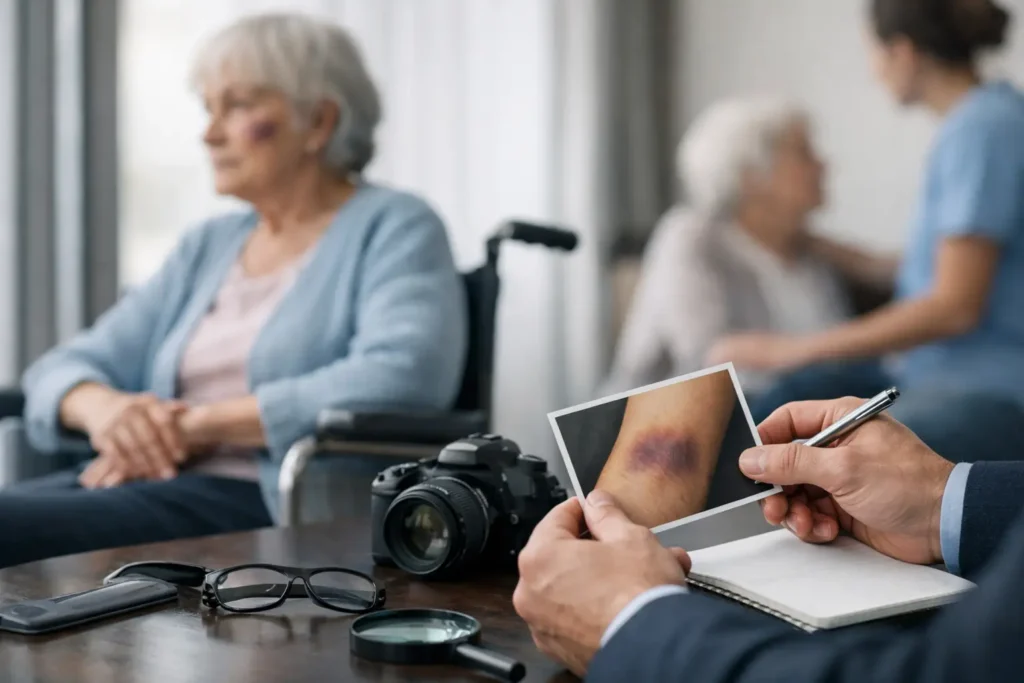
Photos and videos can also be powerful. If your loved one has visible injuries, poor living conditions, soiled bedding, unsafe restraints, or signs of neglect, document them clearly. Try to capture the date and keep the images organized. A single image may be challenged, but a timeline of photographs can show deterioration or repeated harm.
Witness accounts matter too. Other residents, visitors, former staff members, and outside providers may have seen rough handling, heard threats, noticed neglect, or observed understaffing. Not every witness will want to get involved, and some may be afraid of retaliation. Even so, their observations can support a broader pattern.
Facility records may reveal even more than families expect. Staffing schedules, incident reports, care plans, medication logs, fall reports, skin assessments, and internal complaints can all become relevant. Sometimes the issue is not one abusive employee but a larger system failure, such as chronic understaffing or poor supervision.
Financial records can be key if you suspect exploitation. Unexplained withdrawals, missing personal property, sudden changes to account access, or unusual signatures may point to financial abuse.
Medical documentation often carries the most weight
In many cases, the difference between suspicion and proof comes down to medical evidence. A doctor may be able to distinguish between an injury caused by a normal fall and one caused by force. Pressure sores can sometimes show whether basic repositioning and skin care were ignored. Lab results may point to dehydration or malnutrition. Toxicology and medication reviews may reveal overmedication or improper dosing.
That does not mean every injury proves abuse. Elderly residents are fragile, and some conditions develop even with reasonable care. But when the records do not match the facility’s explanation, that gap can become very important.
What Families Should Do Right Away
If your loved one is in immediate danger, call 911 or get emergency medical care first. Safety comes before documentation.
Once the resident is safe, start preserving evidence. Take photos, save voicemail messages, keep discharge paperwork, and request copies of relevant records. If you speak with staff or administrators, write down who you spoke with, when, and what was said. Try to quote exact language where possible rather than relying on memory later.
You should also avoid confronting the situation in a way that gives the facility time to shape its story before records are preserved. It is reasonable to ask questions, but broad accusations too early can sometimes make evidence harder to secure. There is a balance here. You want answers, but you also want facts protected.
Keep a clean timeline
A simple timeline can become one of the most useful tools in the case. Start with the first sign that something seemed off. Include hospitalizations, falls, medication changes, unexplained injuries, staff comments, complaints you made, and any reports to government agencies. A clear timeline helps lawyers, investigators, and medical experts understand how events unfolded.
It also helps when memories blur under stress, which happens to many families. The more serious the harm, the harder it can be to remember details accurately months later.
Reporting the Abuse Can Strengthen the Record
Families sometimes worry that reporting concerns will make things worse. That fear is understandable, especially when a loved one remains in the facility. Still, formal reports can create an important record.
Depending on the situation, concerns may be reported to local law enforcement, adult protective services, the state agency overseeing nursing homes, or a long-term care ombudsman program. If the abuse involves assault, sexual harm, theft, or life-threatening neglect, prompt reporting is especially important.
A report does not automatically prove the case, and not every investigation is thorough. But reports can generate findings, witness interviews, site inspections, and documents that may later support a legal claim.
How to Prove Nursing Home Abuse When the Facility Denies It
Most facilities do not admit fault early. They may blame age, preexisting illness, confusion, or unavoidable accidents. Sometimes those explanations are legitimate. Sometimes they are cover stories for poor care.
This is where outside review matters. An experienced attorney can obtain records, compare the charting to the injuries, identify missing documentation, and work with medical experts to evaluate what should have happened versus what actually happened. For example, if a resident was a known fall risk, the case may turn on whether the nursing home followed the care plan, provided supervision, used alarms correctly, or responded to prior warning signs.
The same is true for bedsores, choking events, fractures, wandering incidents, and medication injuries. These cases are rarely simple. They often depend on whether the facility followed accepted standards of care and whether failures directly caused the harm.
The defense may focus on frailty or illness
Facilities often argue that a resident’s decline was inevitable. That can be a real issue in elder cases because many residents are already medically vulnerable. But vulnerability does not excuse abuse or neglect. In fact, it increases the duty to provide attentive, competent care.
A resident’s poor health may affect damages or causation, but it does not give a nursing home a free pass. The right question is not whether the resident was fragile. The question is whether proper care would have prevented or reduced the harm.
Why early legal help can make a difference
Nursing home abuse cases move on evidence, and evidence does not wait around. Surveillance footage may be overwritten. Staff members may leave. Internal reports can disappear into bureaucracy. Medical conditions change. The sooner a case is evaluated, the better the chance of preserving what matters.
A lawyer can also help families avoid common mistakes, such as relying only on verbal assurances, accepting incomplete records, or waiting too long to investigate. In Pennsylvania and New Jersey, as in other states, legal deadlines can affect your ability to bring a claim. Those deadlines depend on the facts, so waiting can be costly.
For families in Feasterville-Trevose, Philadelphia, and surrounding communities, having a law firm that treats the case with urgency and compassion matters. Kunnel Law handles serious injury and abuse matters with that balance in mind because families need clear guidance just as much as they need strong advocacy.
Proving nursing home abuse is not about finding one perfect piece of evidence. It is about protecting your loved one, preserving the truth, and building a case strong enough to hold the right people accountable. If something feels wrong, do not let uncertainty talk you out of taking the next step.