
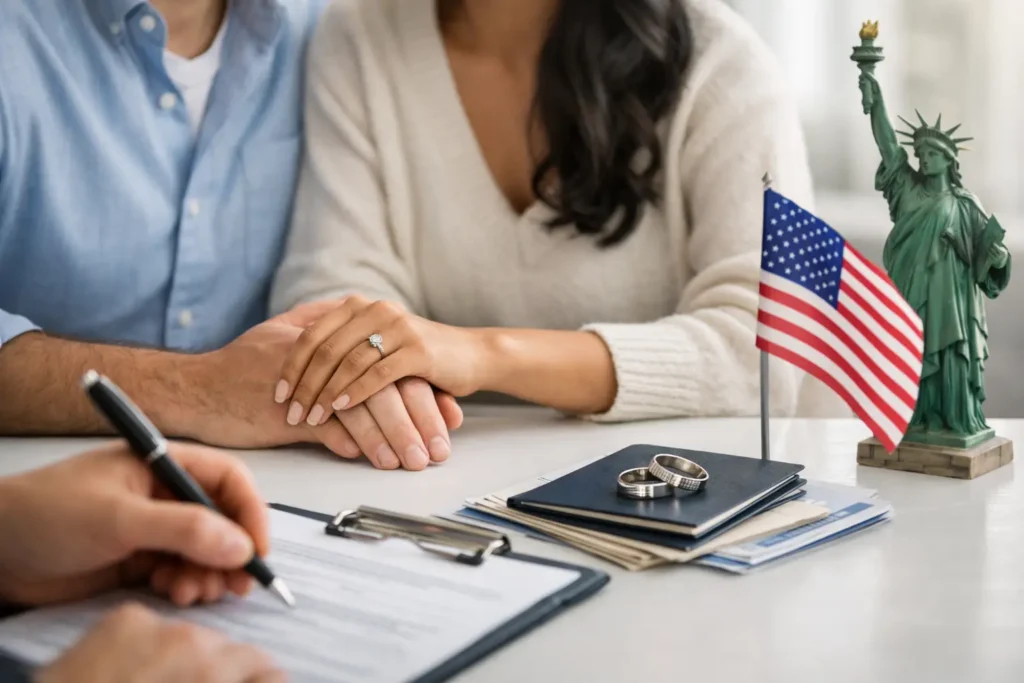
Who Can Use the Adjustment of Status Marriage Process?
Adjustment of status is generally available when the immigrant spouse is physically present in the United States and was inspected and admitted or paroled into the country. In plain terms, that often means the person entered with a visa, was admitted at a port of entry, or received another lawful form of entry authorization.
The U.S. citizen or lawful permanent resident spouse begins the family-based petition. A spouse of a U.S. citizen is classified as an immediate relative, which is significant because an immigrant visa is generally available immediately. In many cases, an immediate relative who overstayed a visa or worked without authorization may still be able to adjust status. That forgiveness does not automatically apply when the sponsoring spouse is a green card holder.
A spouse of a lawful permanent resident falls into a family preference category. That means a visa number must be available before the adjustment application can be approved, and some immigration violations can create additional barriers. Every case should be reviewed individually, particularly where there has been prior removal, unlawful presence, a prior visa denial, entry without inspection, criminal history, or past statements to immigration officials.
Entering the United States without inspection can make adjustment more difficult. Some people may qualify under specialized rules, such as certain protections under Section 245(i), but many will need to consider consular processing or another immigration strategy. Leaving the country without understanding unlawful-presence consequences can trigger serious reentry bars.
The Forms and Evidence Couples Usually File
When a U.S. citizen petitions for a spouse who is eligible to adjust status, the couple can often file several applications together. This is commonly called concurrent filing. The principal forms typically include Form I-130, Petition for Alien Relative; Form I-130A, Supplemental Information for Spouse Beneficiary; and Form I-485, Application to Register Permanent Residence or Adjust Status.
The filing package may also include Form I-864, Affidavit of Support. This is not a casual formality. The sponsoring spouse makes a legally enforceable commitment to financially support the immigrant spouse, and the sponsor must usually meet income requirements. If the sponsor’s income is insufficient, a qualifying joint sponsor may be needed.
Many applicants also submit Form I-765 for employment authorization and Form I-131 for advance parole, which is permission to request travel while the adjustment case is pending. USCIS policies and filing fees can change, so couples should confirm current requirements before submitting any package.
The paperwork must be supported by evidence. That generally includes identity documents, the marriage certificate, proof that prior marriages ended legally, proof of the petitioner’s citizenship or permanent resident status, immigration records, and financial documents for the affidavit of support. Certified translations are needed for documents not written in English.
Just as important is evidence that the marriage is real. USCIS is not judging whether a couple has a perfect relationship. It is assessing whether the couple entered the marriage in good faith, rather than solely to obtain an immigration benefit. Useful evidence can include jointly filed tax returns, a lease or mortgage, joint bank or insurance records, photographs over time, travel records, correspondence, and affidavits from people who know the relationship. The strongest evidence usually reflects a shared life, not a stack of documents created shortly before filing.
What Happens After the Filing
After USCIS accepts the applications, it issues receipt notices. The applicant is then typically scheduled for a biometrics appointment, where USCIS collects fingerprints, a photograph, and a signature for background checks.
If Forms I-765 and I-131 were filed, the applicant may receive an employment authorization document and, if approved, travel authorization before the green card decision. Timing varies substantially. A pending application is not the same as approval, and applicants should not assume they can work or travel merely because the forms were submitted.
Travel deserves special caution. Departing the United States while an adjustment application is pending may be treated as abandoning the application unless the applicant has valid advance parole or falls within a limited exception. Even with advance parole, travel can carry risk for someone with prior unlawful presence, removal history, criminal issues, or other inadmissibility concerns. Individual legal advice before travel is often wise.
USCIS may issue a Request for Evidence if something is missing or unclear. A request is not necessarily a sign that the case will be denied, but it should be answered fully and by the stated deadline. Couples should also report address changes promptly and keep copies of every submission and USCIS notice.
Preparing for the Marriage Green Card Interview
Many marriage-based applicants attend an interview at a USCIS field office. The officer reviews the application, confirms identity and eligibility, and asks questions about the relationship and the applicant’s immigration history. Some cases may be approved without an interview, but couples should prepare as though one will occur.
The best preparation is honest familiarity with the filed paperwork and daily life together. Couples do not need memorized answers. They do need to be able to explain basic facts consistently, such as how they met, where they live, how household expenses are handled, and important events in their relationship.
Bring originals of key civil documents, current proof of the shared relationship, and copies of anything USCIS requested. If circumstances have changed since filing, such as a new address, new child, job change, or updated income information, be ready to address those changes directly.
An officer may separate spouses for questioning when there are concerns about the relationship. That can feel intimidating, but guessing or trying to make an answer sound better usually creates more problems than an honest response. Small differences in recollection are normal. Significant contradictions about central facts require attention.
Common Issues That Can Change the Outcome
The adjustment of status marriage process can be straightforward for an eligible couple, but a few issues require closer analysis. A prior immigration violation may be forgivable in one category but not another. A criminal charge that seems minor under state law may have immigration consequences. Prior applications, inconsistent dates, or inaccurate information on a visa application can lead to questions about misrepresentation.
Timing can also matter. Marrying soon after entering the United States is not automatically improper, and there is no rule that every recent marriage is fraudulent. But if an applicant entered on a temporary visa while secretly intending to immigrate immediately, USCIS may examine whether the person made a material misrepresentation to obtain entry.
Financial sponsorship is another frequent obstacle. The affidavit of support uses specific income rules, and a sponsor’s willingness to help is not enough if the required evidence is missing. A properly qualified joint sponsor can resolve some cases, but the documentation must be complete.
Finally, if the marriage is less than two years old on the date permanent residence is granted, USCIS typically issues a conditional green card valid for two years. The couple must later file a joint petition to remove conditions. If the marriage ends or abuse is involved, a waiver may be available, but the process becomes more fact-specific.
A well-prepared case protects more than a filing date. It gives your family a clear record, a credible explanation of its history, and a stronger foundation for the next step. For couples in Pennsylvania, New Jersey, and beyond who need careful guidance with sensitive immigration paperwork, Kunnel Law can help assess the facts before a small problem becomes a lasting setback.