
What Must Be Proven in a Premises Liability Claim
Property owners and businesses have a duty to take reasonable steps to keep visitors safe. What is considered reasonable depends on the setting, the hazard, who controlled the property, and how long the dangerous condition existed.
For example, a grocery store may not be responsible for every dropped item the instant it hits the floor. But if employees knew about a spill, caused it, or left it unaddressed long enough that reasonable inspections should have found it, the store may be liable for the injuries that follow. Similarly, a landlord may face responsibility for a poorly lit stairwell, defective flooring, or broken entry lock when notice and control can be established.
Insurance companies often focus their defense on notice. They may argue that the hazard appeared moments before the accident, was obvious, or was caused by the injured person. Evidence that addresses these arguments early can make a meaningful difference.
The Best Evidence for Premises Claims
The strongest cases usually do not rest on one item alone. They are built from several forms of proof that tell the same story: what the condition was, how it caused the injury, and why it should have been corrected or warned about.
Photos and Video of the Hazard
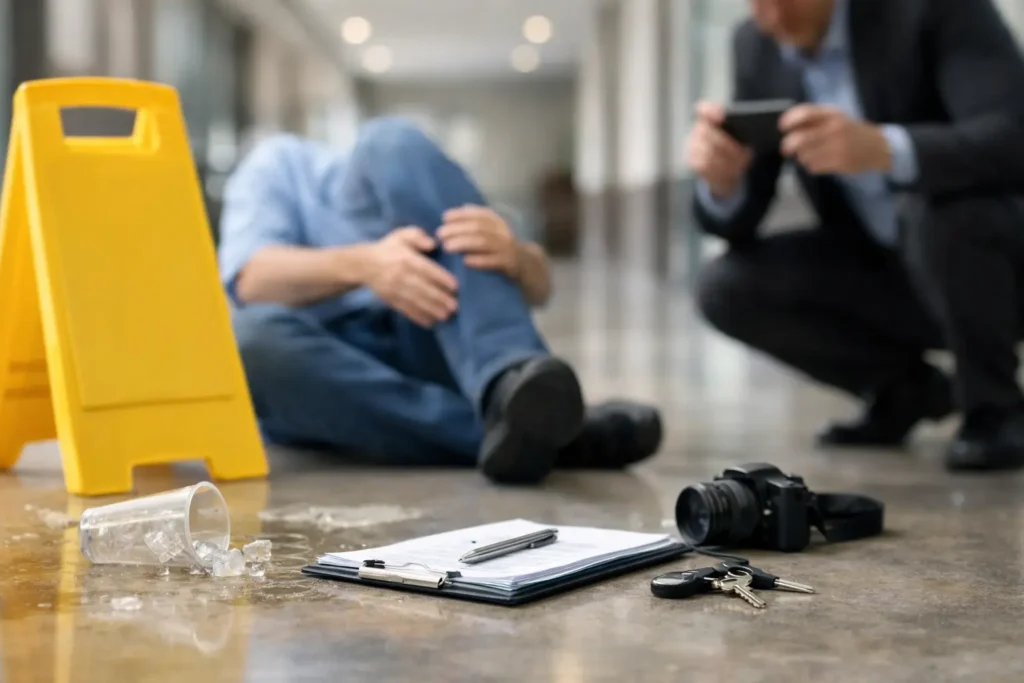
Photos taken immediately after an accident can be among the most valuable forms of evidence. They may show standing water, uneven pavement, poor lighting, missing warning signs, loose carpeting, snow and ice, damaged stairs, or debris in a walkway. Take wide photographs to show the location and close photographs to document the specific danger.
Video can provide additional context. A short recording may show how dim a hallway was, how difficult it was to see a curb, or how a damaged surface affected the path of travel. Photographs of the shoes and clothing worn at the time can also help counter claims that improper footwear caused the fall.
Do not assume surveillance footage will be saved. Many businesses automatically delete recordings within days or weeks. A prompt written request to preserve video can be critical, especially when the incident occurred in a retail store, restaurant, parking garage, apartment building, or other commercial property.
Incident Reports and Prompt Notice
Report the accident to the property owner, manager, supervisor, or security personnel as soon as possible if you are physically able. Ask that an incident report be completed, and request a copy if one is available. Be accurate and concise when describing what happened. Do not guess about facts you do not know or minimize your injuries because you are embarrassed or in shock.
An incident report does not prove liability by itself. It can, however, establish that the property owner received prompt notice of the event. It may identify employees on duty, document the location, and preserve statements made at the scene. If staff members admit they were aware of the problem, write down who said it and what they said.
Witness Statements and Contact Information
Independent witnesses can be particularly persuasive because they have no financial stake in the case. A shopper, neighbor, delivery driver, coworker, or another resident may have seen the accident or noticed the dangerous condition before it happened.
Get names, phone numbers, and email addresses whenever possible. A witness may remember details that become essential later, such as seeing an employee walk past a spill, observing repeated falls in the same area, or noticing that a light had been out for weeks. Memories fade quickly, so a timely statement is far more useful than an account taken months later.
Proof That the Owner Had Notice
In many premises cases, evidence of notice is the difference between a disputed claim and a compelling one. Useful proof may include prior complaints, maintenance requests, inspection logs, cleaning records, repair invoices, employee communications, or reports of earlier incidents at the same location.
Sometimes the condition itself helps establish how long it existed. Dirt tracked through a liquid spill, dried edges around a puddle, rust on a damaged railing, or a long-standing crack in a sidewalk may support an argument that the hazard was not new. An experienced attorney can investigate whether a property owner followed its own safety procedures and whether those procedures were adequate.
Medical Records That Connect the Injury to the Accident
Medical documentation is not just proof of the extent of an injury. It also helps establish causation. Seeking timely evaluation creates a record connecting the fall or other incident to symptoms, diagnoses, treatment, and work restrictions.
Tell medical providers how and where the accident happened. Follow recommended treatment when possible, keep appointments, and retain bills, discharge papers, prescription records, and therapy documentation. If a condition worsens over time, continued medical records can show the real impact of the injury on mobility, work, sleep, and daily life.
Evidence of Financial and Personal Losses
A premises claim should account for more than the first emergency room bill. Keep records of lost wages, reduced work hours, transportation to treatment, medical equipment, home assistance, and out-of-pocket expenses. If injuries affect your ability to care for children, perform household tasks, or return to the job you held before the accident, document those changes.
Serious injuries can leave families facing financial pressure while insurers question whether the accident was truly severe. Clear records help demonstrate the full cost of another party’s negligence.
Evidence That Is Easily Lost
Some evidence requires immediate attention because it may be destroyed, changed, or controlled by the property owner. Surveillance video is a common example, but it is not the only one. The shoes involved in a slip and fall, the torn clothing from a defective stair, the damaged product that caused a burn, and the exact condition of the accident scene can all matter.
Avoid throwing away items connected to the incident. Store them safely and do not attempt repairs or alterations. If weather contributed to the accident, photographs and local weather information may be useful, but conditions can change quickly. The sooner the scene is documented, the harder it is for the responsible party to deny what existed.
Common Mistakes That Can Weaken a Claim
People often make understandable decisions after an accident that later create challenges. They may leave without reporting the event, assume pain will go away, post casually about the accident online, or give a recorded statement to an insurer before understanding the scope of their injuries.
Social media posts can be taken out of context. A photo from a family gathering may be used to suggest you were uninjured, even if you were in pain throughout the event. Insurance adjusters may also ask questions designed to obtain statements about fault, footwear, prior conditions, or the visibility of a hazard. You do not need to accept an early settlement or provide a recorded statement before getting legal guidance.
There are also deadlines for bringing injury claims, and the timeline can be shorter or subject to special rules when a government entity owns or controls the property. Pennsylvania and New Jersey premises claims can involve different laws and procedural requirements. Waiting to investigate can make an otherwise valid case much harder to prove.
How a Premises Liability Attorney Can Help Preserve Proof
A lawyer can move quickly to identify every potentially responsible party, preserve surveillance footage, request records, interview witnesses, and document the scene before repairs erase critical details. This is especially valuable when a business, landlord, contractor, property management company, or government agency may share responsibility.
Kunnel Law helps injured people and families pursue accountability while handling the legal burden during a difficult time. A thorough investigation allows the focus to remain where it belongs: on the unsafe condition, the harm it caused, and the recovery needed to move forward.
If you were injured on someone else’s property, protect your health first, then preserve what you can. A few photographs, a witness name, and a prompt report may provide the foundation for the justice and financial support your family needs.